
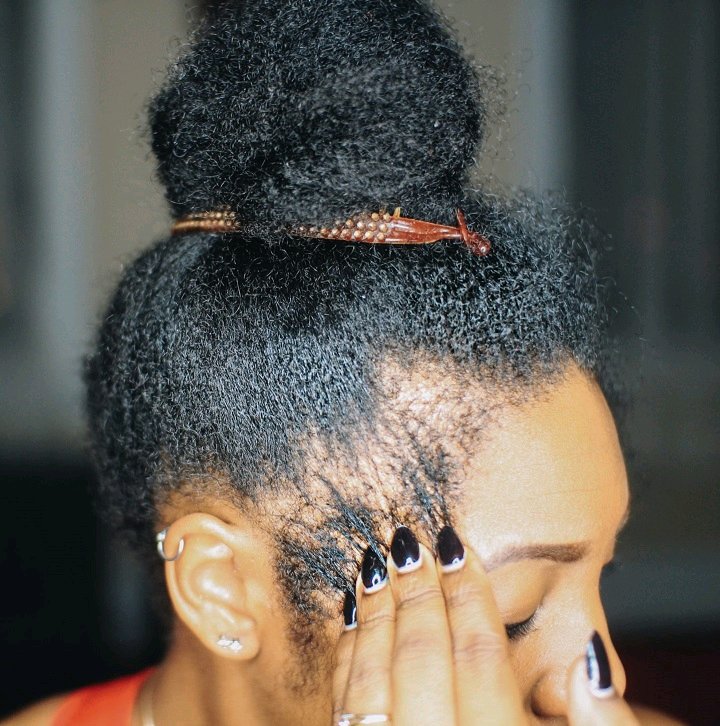
Don’t blame yourself for having thinning or damaged edges. Lots of women will experience the problem at some point in their lives.
Even if you’re doing everything right, your edges can still give you trouble.
That said, taking good care of your hair and adjusting a few key aspects of your hair care routine can help, so we’ve put together a list of ideas to get you started.
1. Be Gentle with Your Hair
When washing, styling, and handling your hair, be gentle, especially around your hairline. Scrubbing, scratching or pulling your hair too tight can easily damage your edges.
If you find yourself absentmindedly pulling or twisting your hair, do your best to break the habit (i.e., hand in hair syndrome). If you have hand in hair syndrome, see how long you can go without touching your hair at all.
The goal is to keep your hands out of your hair as much as possible. Treat your edges with patience and care, like a little garden you’re growing on your head.
2. Keep Your Hair Edges Moisturized (and Conditioned)
There is a reason why people often refer to their hair edges as their “remaining baby hair”, and it’s partly because the hair around your edges often has a different texture or curl pattern than the remainder of the hair on your head.
Because of these differences in hair textures, you may need to consider creating a “customized” unique regimen for your edges, especially if you’re experiencing breakage along your edges
It could be caused by improper moisturizing and conditioning.
Your edges are delicate, and unless your hair is covered, they’re almost always exposed to environmental elements. So, it’s important to ensure that your edges are being regularly moisturized and conditioned.

3. Avoid Tight Braids, Ponytails and Other Hairstyles That Pull Your Edges
Buns, twists, braids, and ponytails can pull on your edges, damaging these baby hairs or stretching them to the point of breaking.
Consider limiting how much you pull your hair back, and when you do, consider a looser look when possible. The tighter the hairstyle, the more it will pull on your edges, potentially leading to damage and breakage.
If you decide to get extensions, be sure to ask your stylist to avoid your edges or treat them with extra care.
During the installation process, you should notify your stylist if you experience any pain. Notifying them quickly allows them to make adjustments to the style before it’s finished.
4. Avoid Hair Damaged Caused by Friction (e.g., via Headbands, Hats, etc.)
You might be tempted to cover up thinning or missing edges, but it’s important to let them breathe when possible.
If you want to wear hats or headbands, try to find ones with silk linings. Alternatively, wear silk or satin scarves in between your hat and your hair.
This will protect your edges from the friction of rougher materials.
Similarly, you can wrap your hair with a silk scarf at night. Silk will help to protect your hair, whereas other types of fabric may absorb the moisture and natural oils from your hair.
It’s probably worth investing in silk pillowcases, to avoid the harsh friction between your hair and cotton pillowcases, which can break and dry out your hairs.

5. Give Yourself a Scalp Massage
Although in most cases it’s best to avoid any contact with your edges, you can make exceptions for the occasional scalp massage.
Slow, gentle rubbing will encourage hair growth by increasing blood flow to your scalp and boosting circulation, which will bring oxygen to your hair follicles.
Using oils when you do this comes with the additional perks of moisturizing, strengthening, and adding a protective layer to your edges.

 9Naija